Happy Birthday to the late and great Lou Gehrig, the greatest First Baseman ever to play the game and one of the five greatest hitters. Gehrig was named “The Iron Horse” because, for 2,130 consecutive games, Gehrig took the field for every game.
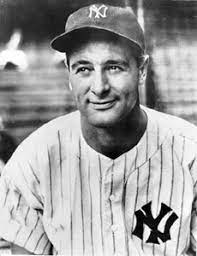
Lou Gehrig Career Statistics/Accolades (1923-1939):
.340 BA, 2,721 HITS, 493 HR, 1,995 RBI, 1,888 RUNS, .447 OBP
- 7x All-Star
- 7x World-Series
- 2x MVP (1927 & 1936)
- 1934 Triple Crown Winner
- 1934 Batting Champion

Here are his year-to-year statistics from Baseball Reference. Regarding Runs, Hits, Doubles, Triples, Home Runs, Runs Batted In, Batting Average, and On Base Percentage, Gehrig has twenty-five black-type numbers, meaning he led the league. WHAT A BALL PLAYER! In 1927, along with Babe Ruth, who hit in front of him for over a decade, he drove in 173 runs despite coming to at-bat sixty times after Ruth cleared the bases with a Home Run. From 1925-1934, he and Ruth combined as the greatest duo in baseball/sports history. However, Ruth was known for hitting high-fly ball home runs, while Gehrig’s home runs were line drives. Gehrig benefitted from hitting behind Babe Ruth, but after Ruth left the Yankees in 1934, Gehrig’s production stayed strong. In the years after Ruth left, Gehrig won an MVP and drove in 150 or more RBIs in both 1936-37; he and the Yankees won the World Series in 1936, 1937, and 1938. For thirteen straight seasons, he drove in 100 or more RBIs; the only two to have done it are Jimmie Foxx and Alex Rodriguez. Speaking of the World Series, in 34 World Series games, here’s what Gehrig did…
.361 BA, 43 HITS, 10 HR, 35 RBI, 30 RUNS, .483 OBP
Gehrig was a great baserunner; nine times, he hit Triples in the double digits, and for thirteen straight seasons, he scored 100 or more Runs. Defensively, he was a lifetime .990 fielder at First Base. In 1938 in the middle of the season, Gehrig started to feel the signs of what would be ALS; still, he finished the year with a (.295 BA, 170 HITS, 29 HR, 114 RBI, 115 RUNS, .410 OBP) stat line, and won his seventh World Series. Unfortunately, he could barely swing a bat the following year and removed himself from the game, ending his consecutive game streak. After being officially diagnosed with ALS, he was forced to say goodbye to the game in his prime. Less than two years after his retirement, Gehrig passed away at 37. Had Gehrig not been forced to call it quits, he would’ve easily reached 3,000 Hits and 500 Home Runs; I also think he would have driven in another 300 RBIs.
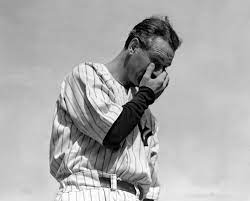
The Yankees picked Gehrig as the team’s captain for his on-the-field performance and for being a class act on and off the field. Despite his success, he always remembered how important it was to never take his job for granted and always took pride, whether on or off the field. After Gehrig, the Yankees only named a team captain Thurman Munson in 1976. He was the first Yankee to have his uniform retired by the team before Ruth. His consecutive games streak would be broken in 1995 by Cal Ripken Jr, named “Iron Man.” Since 1955, the ‘Lou Gehrig Memorial Award” has been given annually to a ball player who best exhibits the character and integrity of Gehrig on and off the field. Lou Gehrig isn’t just a Hall of Fame member; he’s in the small room part of the Hall of Fame.
References:
- Lou Gehrig Career Statistics via Baseball-Reference: https://www.baseball-reference.com/players/g/gehrilo01.shtml
- Lou Gehrig via Wikipedia: https://en.wikipedia.org/wiki/Lou_Gehrig#
 MLB Past & Present